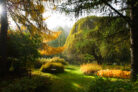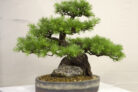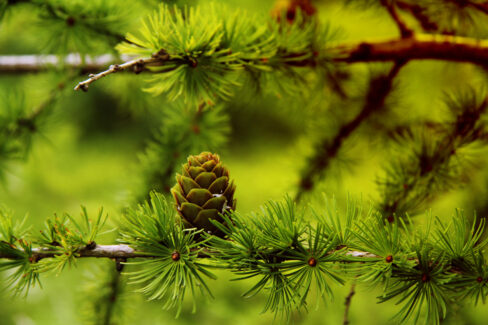
The larch is a conifer, but it’s definitely not your average evergreen! In fact, it has a few quirks that make it stand out from the crowd—like the fact that it actually drops its needles before winter. It also puts on a stunning floral display, though you might have to wait a few years to see it. Here’s a quick guide to the unique characteristics and growth habits of the larch.
Name, Origin, and Varieties
Botanically speaking, the larch belongs to the pine family (Pinaceae). This family includes about 20 different species, but there are three main types you’ll likely run into. Each one has adapted to the specific climate of its homeland.
The most well-known varieties:
- Larix decidua (European Larch)
- Larix kaempferi (Japanese Larch)
- Larix sibirica (Siberian Larch)
European larches are native to the mountain ranges of Central Europe, so they are perfectly adapted to cold winters. The Japanese larch hails from Asia, while the Siberian larch comes from—you guessed it—Siberia.
How the Larch Grows
Larches can reach towering heights of up to 160 feet and live for centuries. If you plant one in the right spot and let it do its thing, you’ll eventually have a majestic giant with a beautiful canopy right in your backyard.
Larch Quick Facts:
- Lifespan: Can live 400 years or more
- Height: Up to 160 feet
- Root system: Heart-shaped root system
- Leaf type: Needles
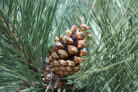
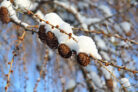
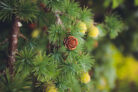
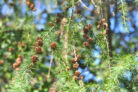
- Fruit: Cones
- Bark: Starts out smooth and green, turning brown and scaly with age
Those Unique Larch Needles
Did you know the larch is one of only two conifers that sheds its needles? Most people think “evergreen” means “always green,” but the larch plays by its own rules. Because its needles have tiny pores that release moisture, the tree drops them to survive the winter. If it kept them, it would lose too much water through evaporation while the ground is frozen and the roots can’t drink.
Characteristics of larch needles:
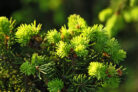
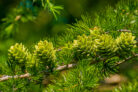
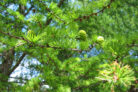
- Color: Start bright green, turn dark green, then shift to yellow or bronze in the fall
- Growth: They grow in soft clusters along the branches
- Texture: Blunt tips and very flexible/soft to the touch
- Size: Between 0.4 and 1.2 inches long
The Larch Bloom
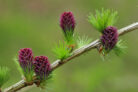
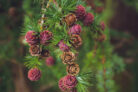
Aside from the needles, the flowers are the larch’s other claim to fame. However, you’ll need some patience—a larch won’t bloom until it’s at least 15 years old. If the growing conditions aren’t ideal or if the area is too crowded, it might even take 40 years to see the first flower! When they do appear, the female flowers are especially stunning with their bright pink hue. Just keep in mind that the tree doesn’t necessarily bloom every single year.
What the flowers look like:
- Female flowers: Spectacular pink color (about 0.4 to 0.8 inches)
- Male flowers: Yellow or gold-toned (about 0.2 to 0.4 inches)
- Development: These flowers eventually turn into the tree’s cones
- Seeds: The tree’s seeds are tucked safely inside those cones