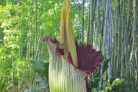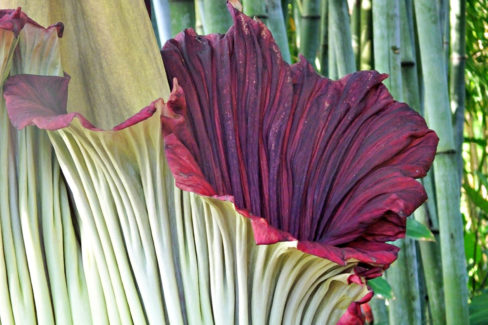
The Titan Arum—better known as the “Corpse Flower”—is one of those plants you usually only get to see at a major Botanical Garden. Originally hailing from the tropical rainforests of Sumatra, this giant belongs to the Arum family. Just a heads-up: it’s toxic, and as the name suggests, its bloom smells absolutely putrid!
How the Titan Arum Grows
It all starts with a massive underground tuber (called a corm) that can easily tip the scales at 60 to 90 pounds. Every so often, this tuber sends up a single, giant leaf that can stick around for up to a year and a half. Eventually, that leaf dies back, and the roots wither away. But during that time, the leaf has been busy soaking up nutrients to store in the tuber. This cycle of growth and dormancy repeats until the tuber hits a “sweet spot” weight—usually at least 45 pounds. Once it reaches that ideal size (which only happens every seven to ten years), it finally has enough energy to produce a flower.
The Beautiful (but Stinky) Bloom
Botanical gardens all over the world are incredibly proud to host these giants. You can find them in places like:
- The New York Botanical Garden in the Bronx
- The United States Botanic Garden in D.C.
- Various famous gardens across Europe, like those in Bonn, Frankfurt, or Stuttgart
Whenever a bloom is imminent, it’s a huge event that draws in crowds and news crews alike.
The actual flowering only lasts about 20 hours and mostly happens at night. At first, the massive central spike (the spadix) is wrapped in a large bract. As it slowly unfurls, it releases a scent that smells like a mix of sewage and rotting meat. The dark red or deep purple bract looks like an elegant pleated skirt as it opens up to reveal the giant spike inside. Down at the base, you’ll find tiny orange-red flowers ready for pollination. That signature stench is at its peak right now, tricking insects into thinking they’ve found a great place to lay their eggs. They eventually leave, frustrated, but not before they’ve successfully pollinated the plant.
A few hours later, the male flowers join the party, releasing sticky pollen threads that hang down like spaghetti. Ideally, the female flowers have already been pollinated by pollen from a *different* plant, as they don’t usually self-pollinate. Interestingly, successful fertilization is pretty rare in botanical gardens; it seems to happen much more easily in the wild. If it is successful, bright red berries will form. If not, the flower simply dies back, the growth phase ends, and the plant goes back to sleep.