If you’re looking for the “Titan Arum” in your neighbor’s backyard or sitting on a living room windowsill, you’re going to be looking for a long time! This rare, exotic giant is native to the tropical rainforests of Sumatra. It belongs to the Araceae family (the aroids), and while it’s not your typical garden variety plant, it has some pretty fascinating quirks.
The Aroid Family Connection
Believe it or not, the Titan Arum is a relative of the common Cuckoo-pint (Wild Arum) found in many parts of Europe. Despite the massive difference in size, these two cousins have a lot in common:
- Both are herbaceous plants.
- They grow from an underground storage organ called a tuber.
- They use “pitfall” pollination tactics.
- Both trick tiny insects into pollinating them using specific scents.
- They both smell… well, pretty bad. While the Wild Arum smells like urine, the Titan Arum smells like rotting meat (hence its nickname, the “Corpse Flower”).
- They each produce a single, massive spadix (the spike in the middle).
- Both are highly toxic if ingested.
What Does a Titan Arum Look Like?
Standing up to ten feet tall, this plant thrives in the hot, humid jungle. It grows from a massive tuber and typically produces just one single, giant leaf at a time. This leaf can stay green for up to a year and a half! The leaf stalk is even covered in light spots to mimic lichen, tricking animals into thinking it’s unpalatable. While that giant leaf is soaking up the sun, the plant is busy storing energy in its tuber, which gets heavier and heavier. This is known as the “vegetative phase.” Once that phase ends, the plant goes dormant—the leaf dies back, the roots wither, and the tuber takes a well-deserved nap.
The Bloom
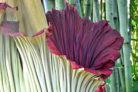
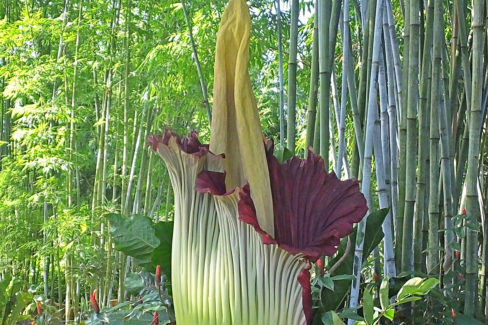
After cycling through several growth and dormant phases, the tuber needs to weigh at least 45 pounds (20 kg) before it has enough energy to flower. When it finally happens, it’s a showstopper. A giant spike (the spadix) emerges, wrapped in a protective bract that slowly unfurls. The result is a single, ruffled, pleated “skirt” in deep shades of burgundy, maroon, or dark purple. Inside, thousands of tiny orange-red flowers are revealed. As soon as it opens, the female flowers are ready for pollination, and the plant begins to emit that infamous, pungent smell of rotting carrion. A day later, the male flowers release their sticky pollen. If pollination is successful, the plant produces bright red berries—though this is a rare sight! If no pollination happens, the bloom simply dies back, and the plant returns to its cycle of dormancy and growth for several more years until the next big show.