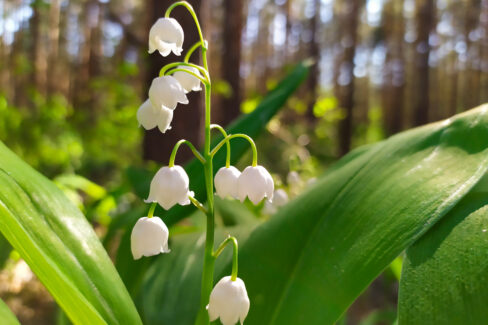
If you’re browsing the garden center, you’ll usually find Lily of the Valley tucked away in the flower bulb section. But here’s a little botanical secret: calling them “bulbs” is actually a bit of a misnomer! Biologically speaking, Lily of the Valley bulbs don’t actually exist.
A Classic Perennial
Even though Lily of the Valley is one of our favorite early spring bloomers, it isn’t a bulb plant at all. It’s actually a hardy perennial. Instead of bulbs, it grows from rhizomes. When you buy them to plant, those little root-like structures are what you’re actually getting. You can tell them apart from bulbs pretty easily just by looking at them. A bulb usually has roots at the bottom and a single “eye” or point at the top where the flower pops out. Rhizomes, on the other hand, look like horizontal underground stems with multiple eyes, each capable of sending up a new shoot.
Dividing the Rhizomes
The way these plants spread is also totally different from your typical tulips or daffodils. When you want to propagate bulb plants, the mother bulb grows little “baby” bulbs (offsets) that you can dig up and move to new spots in your garden. With a rhizome, you propagate by division. Lily of the Valley is particularly vigorous in this department—even a tiny piece of a rhizome can take root and start a whole new patch. This is exactly why removing them from a garden bed can be such a challenge; if you leave even a small fragment behind in the soil, they’ll be back before you know it!
Planting is Pretty Familiar
The good news is that when it comes time to get them in the ground, the process is very similar to planting bulbs. Here’s the play-by-play for both:
- Dig your planting hole.
- Mix in some mature compost to give the soil a nice nutrient boost.
- Place the rhizome (or bulb) in the hole with the “eyes” pointing upward.
- Fill the hole back in and gently tamp down the soil with your foot.
Getting that orientation right is the most important part! If those eyes are pointing down, the plant will try to grow deeper into the earth instead of up toward the sunshine. Keep those points facing the sky, and you’ll be enjoying those fragrant white bells in no time.