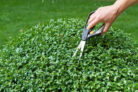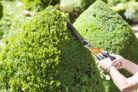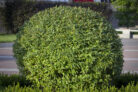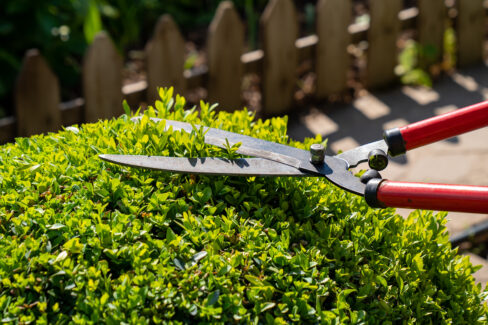
Boxwoods are incredibly versatile when it comes to shaping. While those fancy, imaginative topiary designs require a steady hand and a real eye for detail, almost anyone can master geometric shapes. The secret? Using a template. You can pick one up at the store or, if you’re feeling crafty, make your own on the cheap.
Buying Ready-Made Templates
You’ll see geometrically shaped boxwoods just about everywhere. Whether you’re dreaming of a perfect sphere, a cube, a spiral, or a pyramid, a template ensures your contours are spot on. You can find pre-made wire frames at most garden centers. Usually, you just pop these wire mesh forms over the bush and leave them there to act as a guide for your shears. Just a heads-up: store-bought models come in fixed sizes, so they aren’t very adjustable.
DIY Templates
You can easily build your own templates at home with basic supplies. Not only does this save you some cash, but it also means you aren’t limited by size. If you only need a guide for a quick one-time trim, even some old cardboard will do the trick. For something more durable, garden stakes, wire, and mesh are your best friends.
- For a pyramid shape, tie four stakes together at the top like a tent.
- This “tent” method works great for cones, too.
- To get a perfect sphere, cut a semi-circle (matching half the diameter of your desired globe) out of cardboard or thin plywood.
- Hold the semi-circle against the boxwood and trim along the edge.
- Alternatively, bend thick wires into arches over the bush and anchor them in the soil.
- For a cube, you can easily fold a guide out of wire mesh.
Pro Tip:
If you want your topiary to grow larger over the years, just use a slightly bigger template each season. Once it reaches its “forever size,” you’ll just need to do maintenance trims by clipping back the new growth.
The Pre-Cut Phase
Since boxwoods grow so densely, it can be a struggle to jam them into a template if they’ve grown way out of bounds. My advice? Give the bush a rough “pre-cut” without the template first. Just eyeball it to get the general shape. Wait about four weeks, and then bring in the template for the fine-tuning. Once the boxwood has its basic structure, keeping it in shape becomes a total breeze.
When to Prune
The first big topiary trim should happen right after the first flush of new growth in the spring—usually late April or early May, depending on the weather. Follow that up with a maintenance trim in July to tidy up any stray shoots. For simple geometric shapes, these two sessions are usually plenty. If you’re a perfectionist and want those lines extra sharp, you can trim anytime between April and mid-September. Just make sure to give the plant at least four weeks to recover between haircuts.
Pro Tip:
Intricate topiary work creates a ton of tiny clippings. To save yourself a headache, spread a tarp or cloth around the base of the plant before you start. Your back will thank you later!
Trimming a Boxwood Hedge
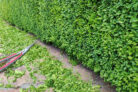
A hedge is essentially a long rectangular prism, which is pretty easy to cut even without a guide. However, here’s a pro secret: always trim the top slightly narrower than the base. This “tapered” look ensures that sunlight reaches the bottom leaves, keeping your hedge lush and green from top to bottom.