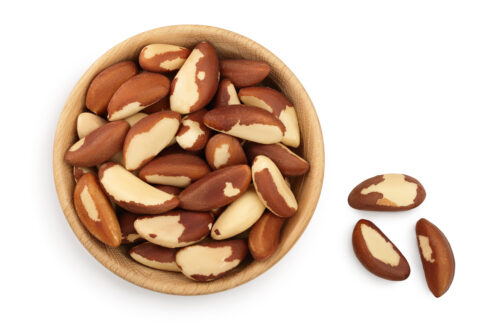
Brazil nuts and pecans aren’t exactly local backyard staples for most of us, so they don’t always make it into the daily snack rotation. Since they both start with a “P,” people tend to lump them together, but trust me—each one is a totally unique nut with its own personality!
Brazil Nuts: The South American Powerhouse
Brazil nut trees grow wild in the lush rainforests of Brazil and neighboring countries. These giants are slow starters, taking over a decade just to bloom and produce fruit. The fruit itself actually looks a bit like a coconut from the outside. Inside each pod, you’ll find about 20 to 40 seeds—those are the nuts we eat! They are incredibly healthy, but getting to the good stuff is a workout because the shells are rock-hard. That’s why you’ll mostly find them already shelled at the grocery store.
What’s Inside a Brazil Nut?
Brazil nuts are definitely rich, packing about 660 calories per 100 grams. But don’t let that number scare you off; we’re talking about those “good fats” your body loves. What really makes them famous, though, is their massive selenium content (about 1.9 milligrams per 100 grams). As far as we know, no other plant on Earth offers more selenium. It’s a vital trace element for our bodies, and eating just one single Brazil nut can meet an adult’s entire daily requirement! They also pack a punch with fiber, vitamins C, B6, B12, and E, plus a long list of minerals:
- Calcium
- Iron
- Potassium
- Magnesium
- Sodium
- Phosphorus
- Zinc
Quick Tip:
Brazil nuts can go rancid or get moldy if they sit around too long. Instead of stocking up on a huge bag, it’s better to buy smaller amounts more often. If you can find them in the shell, crack them right before you eat them for the freshest flavor.
Pecans: A North American Classic
The pecan tree is a true North American native, though you’ll find it growing in the Southern Hemisphere these days, too. It’s actually a member of the hickory family and a close cousin to the common walnut. Unlike the tough Brazil nut, pecans have a relatively soft shell that you can sometimes even crack by hand. While they don’t have nearly as much selenium and are a bit higher in fat, they are still a nutritional powerhouse. They’re loaded with:
- Iron
- Potassium
- Calcium
- Magnesium
- Phosphorus
- Zinc
- Vitamins A, B, C, and E
Can You Grow Them at Home?
If you’re thinking about planting a Brazil nut tree, I’ve got some bad news. They need a strictly subtropical climate. You might be able to keep a sapling alive in a greenhouse with plenty of heat and humidity, but it’s unlikely to ever flower or fruit here. Plus, in the wild, they rely on a very specific type of jungle bee for pollination.
Pecans, on the other hand, are much more resilient! They can handle temperatures down to -20°F. If you have a sunny, warm spot in your yard, a pecan tree can actually thrive and become a beautiful addition to your landscape.