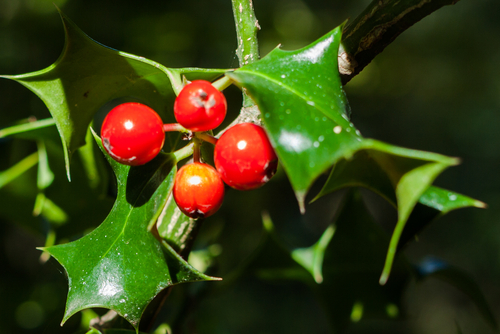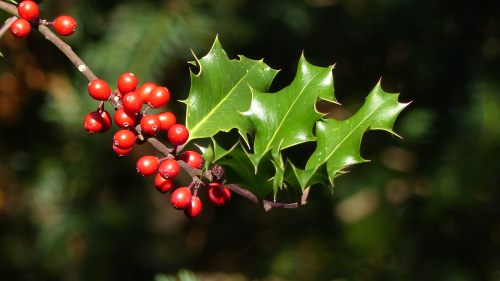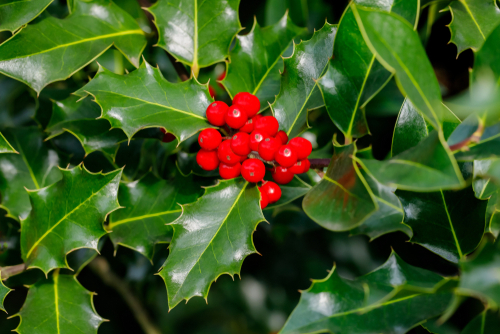
Holly is a classic staple in our gardens and parks. In the spring, the female shrubs show off tiny white blossoms, which eventually turn into those iconic red berries we see in the fall. But here’s the thing: you’ll never see a holly bush with bright yellow flowers. If you think you’ve spotted one, you’re likely looking at a case of mistaken identity!
Yellow or White Flowers: Is it Really a Holly?
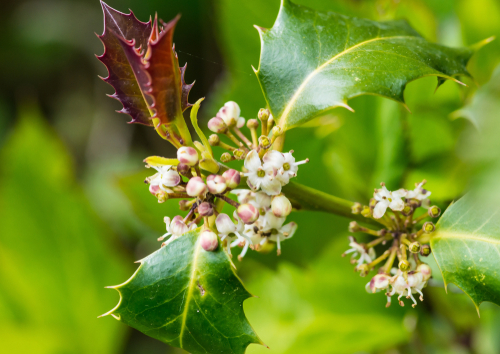
True Holly (Ilex) blooms in the spring with small, creamy-white flower clusters.
Right around the same time, another shrub with prickly leaves puts on a show with delicate, bunched-up blossoms—but these are a vibrant, sunny yellow. At first glance, it’s easy to mistake it for a Holly because of those evergreen, spiny leaves, but what you’re actually looking at is a Mahonia (also known as Oregon Grape).
Meet the Common Mahonia
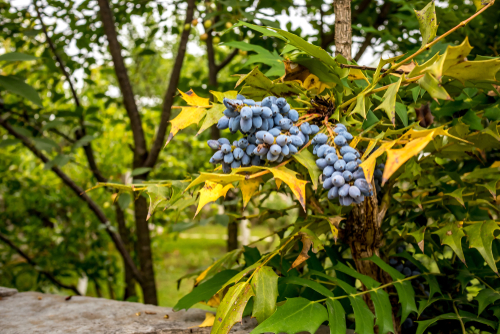
Mahonia is an upright, multi-stemmed evergreen that usually reaches about 6 feet in height. Its glossy, dark green leaves are “pinnate” (meaning they grow in pairs along a stem) with wavy, prickly edges. From March through June, it produces stunning clusters of bright yellow flowers. By August, these transform into purplish-black berries with a dusty blue coating. While the berries are technically edible, they are incredibly sour!
A word of caution: the plant is considered toxic in all its parts. While you can eat a few raw berries, larger amounts need to be cooked down first to be safe.
Mahonia vs. Holly: Spot the Difference
Both of these plants are gorgeous additions to any landscape, and if you’re just passing by, it’s easy to mix them up. Even though they look like cousins, they actually belong to completely different plant families. Let’s break down the differences so you can tell them apart like a pro.
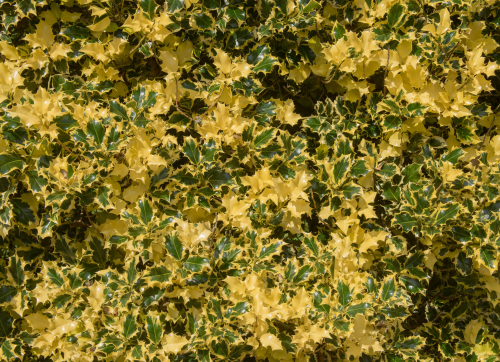
Holly (Ilex aquifolium)
The European Holly belongs to the Aquifoliaceae family.
Key Features:
- Grows as a tall shrub or even a large tree.
- Can reach heights of over 30 feet.
- Can live up to 300 years!
- Evergreen, glossy, oval leaves with thorny teeth.
- Blooms white to creamy-white in the spring.
- Dioecious (meaning you need a male and female plant for berries).
- Bright red berries appear on female plants in the fall.
- The entire plant is toxic.
- Loves full sun to partial shade.
- Prefers nutrient-rich, well-draining, moist soil.
- Doesn’t handle drought very well.
Mahonia (Oregon Grape)
This beauty belongs to the Berberidaceae (Barberry) family.
Key Features:
- A wide, bushy small shrub.
- Usually tops out at around 5 feet.
- Alternate, evergreen leaves that are dark green with thorny edges.
- Blooms bright yellow in the spring.
- Bell-shaped flowers grow in upright clusters (racemes).
- Produces blue-black, slightly toxic berries starting in August.
- Thrives in sun to partial shade.
- Prefers nutrient-rich, well-draining soil.
- Much more drought-tolerant than Holly.