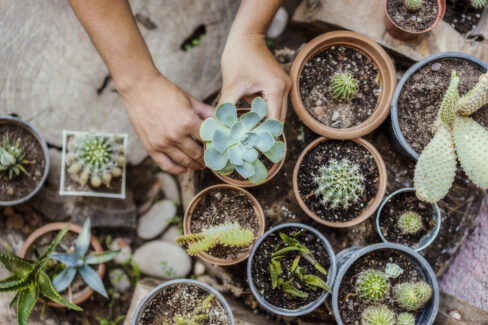
Succulents aren’t just incredibly low-maintenance and hardy roommates; they also bring a touch of magic to any garden bed or windowsill with those fascinating leaf rosettes and dainty blooms. The best part? Almost every succulent variety is super easy to propagate.
Method #1: Growing Your Collection with “Pups”
If you have succulents that grow in a single, unbranched form, they basically hand you a propagation shortcut on a silver platter. These varieties produce their own “babies” in large numbers, which are officially called offsets—or, as we plant parents like to call them, “pups.”
These little side-shoots sprout at the base of the mother plant and look like miniature versions of the original. While most plants require you to wait until these pups have grown their own roots, succulents are much more forgiving—you don’t necessarily have to wait that long before making the cut.
How to harvest pups correctly
To take offsets from your mother plant, just follow these simple steps:
- Pick a pup that has already clearly taken on the shape of the mother plant.
- Grasp the pup between two fingers and gently snap it off.
- If it doesn’t pop off easily, you can use a clean, sharp knife to cut it away.
- Let the “wound” on the baby plant air-dry for a day or two until it calluses over.
- Once dry, place the pup into a pot filled with moist succulent or cactus soil.
- Press the soil down firmly to ensure the base of the plant has good contact with the substrate.
Pro Tip: Give your new plant about a week to settle in and regenerate before you start watering it.
Method #2: Leaf Cuttings
For succulents with plenty of leaves (like Agaves, Jade plants, or ZZ plants), leaf cuttings are your best bet. The goal here is to get a single leaf to root along a cut edge, eventually sprouting one or more tiny new plants.
The best time to try this is in early spring. This gives the leaf cutting the whole summer to soak up the warmth and make the most of the growing season.
How to take leaf cuttings the right way
If you want to grow new plants from scratch using leaves, here’s the game plan:
- Fill a tray or pot with a mix of seed-starting soil and coconut coir.
- Mist the mix with soft water.
- Snap or cut the desired number of leaves off the mother plant.
- Using a razor blade, carefully trim a very thin sliver off the edge of the leaf to expose the fresh, juicy tissue.
- Lay the prepared cuttings flat on the moist soil and press them down gently.
- Over the next few days, tiny mini-succulents will start to form along that exposed tissue.
- Keep the soil lightly misted with lukewarm water whenever it starts to feel dry.
- Once the rooted mini-succulents reach about an inch (3 cm) in height, you can carefully snip them away from the original leaf.
- Now it’s time for them to be repotted into small individual pots, where they can focus on growing strong roots.
- Use your finger to poke a small hole in the soil first so you don’t damage those delicate new roots when planting.
Method #3: Growing Succulents from Seed
The first two methods (pups and leaf cuttings) are forms of “vegetative” propagation, which is great for growing a few plants at a time. But if you want a whole succulent family, you might want to try “generative” propagation—aka growing them from seeds.
Fair warning: This method is more work and takes significantly longer than the others. It also requires a bit of a “green thumb” and some patience.
How to grow succulents from seed
Whether you’ve harvested seeds from your own plants or bought them from a shop, here is the best way to get them started:
- Fill a seed tray with lean seed-starting soil over a roughly 1/2-inch layer of drainage material (like expanded clay pebbles).
- Get the soil nice and damp using lime-free water.
- Sift a thin layer of lime-free quartz sand over the top of the soil.
- Scatter your succulent seeds across the surface and press them down lightly with a small flat board.
- Cover the tray with a glass pane or some plastic wrap to create a mini-greenhouse effect.
- Place the seeds in a bright spot with indirect light at about 77°F (25°C).
Caring for succulent seedlings
The exact germination time depends on the specific succulent species, but you’ll usually see sprouts within two to three weeks. Under their glass or plastic cover, the seedlings enjoy a warm, humid climate that shouldn’t need extra watering at first.
Make sure your seeds aren’t sitting in direct sunlight during this phase. Once the first little sprouts are visible, the cover has done its job and can be removed. Now the seedlings can mature in the fresh air. This whole process is a marathon, not a sprint—it can take up to 12 months before the seedlings are sturdy enough to be pricked out and moved to their own pots.