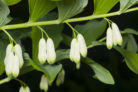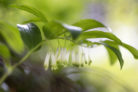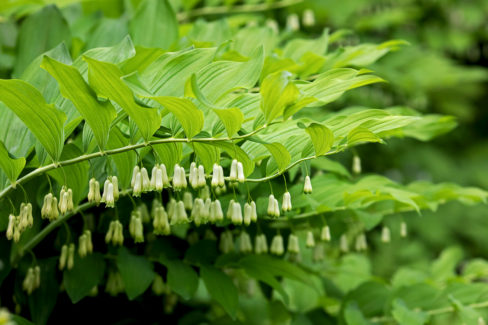
You’ll usually spot Solomon’s Seal tucked away in the woods or hanging out in shadier clearings, but thanks to its unique, elegant look, it’s become a real favorite for home gardens. One quick heads-up, though: people often mix up the “True” Solomon’s Seal (also known as Fragrant Solomon’s Seal) with its cousin, the Many-Flowered Solomon’s Seal.
True Solomon’s Seal or “Fragrant Solomon’s Seal”
True Solomon’s Seal often goes by the name “Fragrant Solomon’s Seal.” In some circles, it’s also called “White Root” because of its distinct white rhizomes (underground stems). Because the names and looks are so similar, it’s super common for gardeners to compare it to the Many-Flowered variety.
How to Tell the Difference
While they definitely look like siblings, there’s one easy trick to tell True Solomon’s Seal apart from the Many-Flowered version:
- True Solomon’s Seal has a very distinct, sharp-edged (angular) stem. Its green leaves stand upright, and the bell-shaped flowers usually hang out solo or in pairs.
- On the other hand, the Many-Flowered Solomon’s Seal grows its blossoms in little clusters of three to five flowers per stem.
What’s Inside: A Note on Toxicity
It’s important to know that all parts of the Solomon’s Seal plant contain saponins, chelidonic acid, and other compounds that make it toxic. The berries are actually the most dangerous part. If someone accidentally eats them, it can lead to some nasty symptoms like nausea, vomiting, and diarrhea.
Because it triggers these reactions, various cultures have actually used the plant historically as an emetic (something used to induce vomiting).
Growing Solomon’s Seal in Your Garden
If you have a tricky, shady spot in your yard where nothing seems to grow, Solomon’s Seal might be your new best friend! It’s the perfect choice for those locations that don’t get much sun. It thrives in shade or partial shade and loves loose, well-draining soil, though it’s pretty hardy and can handle clay or even swampier conditions just fine.
If you’re short on garden space, some of the more compact, lower-growing varieties work great in:
- Pots and containers
- Balcony planter boxes
Watch Out for Sawflies
One thing to keep an eye on is sawflies. These pests absolutely love Solomon’s Seal. The tricky part is that they are very loyal to their “home” spot—once they find your plants, they’ll likely come back year after year to lay their eggs. Keep a close watch on those leaves!