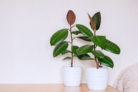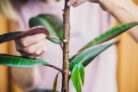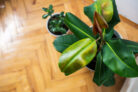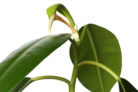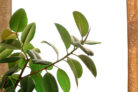
When you think of a Rubber Tree (*Ficus elastica*), you probably picture those iconic, oversized, glossy dark green leaves. Red leaves? Not usually part of the vision. Yet, every so often, you’ll spot these long, reddish structures popping up on your plant. If you’re wondering what on earth is going on, you’re not alone!
The Mystery of the “Red Leaves”
There are plenty of theories floating around about what these red spikes actually are. Some of the most common guesses include:
- A red flower
- Leaf damage or disease
- A new leaf
A Red Flower?
If you were hoping those red, elongated parts meant your Rubber Tree was finally blooming, I hate to be the bearer of bad news. It’s definitely not a flower, nor is it a bud that died off too early. In reality, *Ficus elastica* flowers are actually quite small and unimpressive—and honestly, they almost never appear when grown indoors as houseplants.
Leaf Damage?
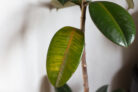
If you see a long, dark red or even bright red growth, don’t panic—it’s not a disease or a pest infestation. While the dreaded leaf spot disease (a fungal infection) can cause reddish spots along with yellow and brown ones, those usually show up as blotches on the leaf surface itself, not as a separate structure.
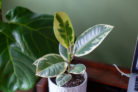
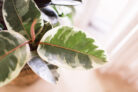
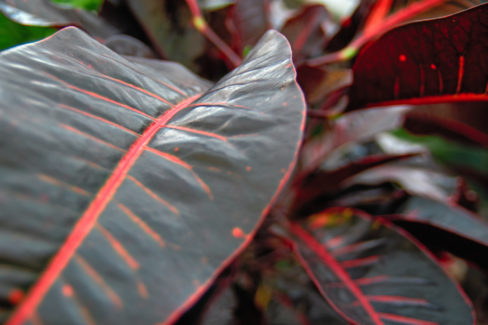
Now, if your entire leaf has a reddish tint, you might just have a specific variety like the “Melany.” Or, if the undersides of the leaves are a deep red, you likely have a “Belize.” That colorful variety is famous for its gorgeous mix of green, white, orange, and red on the top of the leaves!
Solving the Mystery
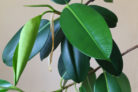
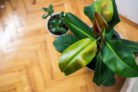
The answer is actually pretty simple: those long, red sheaths are just how new leaves grow! It’s a sign of a happy, growing plant, so you can breathe a sigh of relief regarding your Rubber Tree’s health.
Technically speaking, these red parts are “stipules” that have fused together to form a protective casing for the developing leaf. Because this sheath can grow up to four inches long, it’s easy to mistake it for a flower bud. Once the new leaf is ready to unfurl, the sheath has done its job. Since the plant doesn’t need it anymore, it simply dries up and falls off.