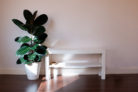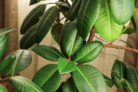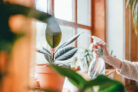
The Rubber Tree, or *Ficus elastica* as the pros call it, is a total staple in American homes thanks to those gorgeous, glossy leaves. But did you know they actually produce flowers? It’s true! However, they’re super low-key and honestly, seeing one on a potted plant is like finding a four-leaf clover.
When Does a Rubber Tree Bloom?
You might see some garden centers label these as “non-flowering” plants, but that’s a bit of a myth. While *Ficus elastica* definitely has the DNA to bloom, it rarely happens when they’re living indoors. Even if you give yours a little “summer vacation” out on the patio, it’s usually not enough to trigger any buds.
If you’re a patient gardener, don’t lose hope just yet—some Rubber Trees don’t decide to show off their first flowers until they’re about 40 years old! Just a heads-up, though: don’t expect a flashy floral display. These blooms are tiny and very easy to miss.
What Do the Flowers Look Like?
The Rubber Tree is “monoecious,” which is just a fancy way of saying it grows separate male and female flowers on the same plant. It even has sterile “gall flowers.” All of these are tucked away inside a small inflorescence (a cluster of flowers). They’re almost stalkless, measuring only about 10 x 5-8 millimeters, and usually grow in pairs tucked into the leaf axils on smaller branches.
The reason they’re so plain? Evolution! In the wild, the Rubber Tree relies on a very specific type of symbiotic fig wasp for pollination. Since it doesn’t need to attract bees or butterflies, it doesn’t waste energy on bright colors or sweet scents.
Male Flowers
- Have a small stalk
- Feature four sepals
- Contain one stamen without a filament
Female Flowers
- No stalk (sessile)
- Feature a long style with a stigma at the tip
Gall Flowers
- Feature four sepals
- Have a short, curved style
Wait, Is That a Red Flower?
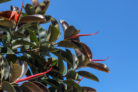
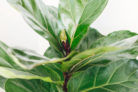
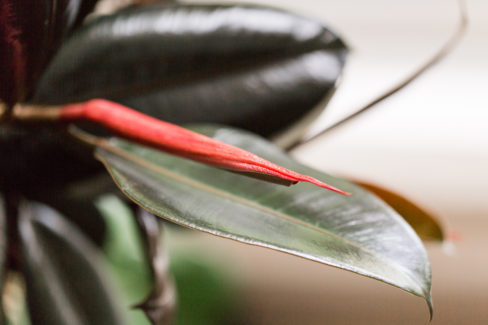
If you see something bright red poking out of the top of your plant, it’s probably not a flower. New leaves grow inside a protective sheath called a stipule. These are often a vibrant red and look super decorative, so it’s easy to mistake them for a bloom!
The Fruit
In the rare event that your Rubber Tree actually flowers, it might even produce fruit. These little “figs” are:
- Yellowish-green
- Oval-shaped
- About half an inch long
Just a word of caution: these figs are definitely not for snacking—they’re considered inedible. Also, don’t bother trying to plant the seeds. Unless that specific fig wasp happened to stop by your living room, the seeds won’t be fertile!