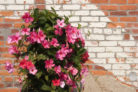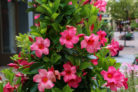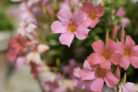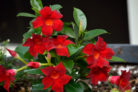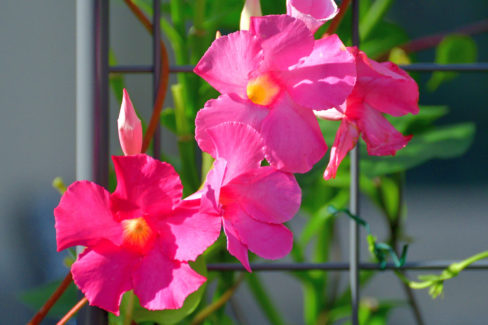
Dipladenia (also known as Mandevilla) is incredibly versatile for your balcony. You can let it trail beautifully from a hanging basket or tuck it into a window box. But if you really want a showstopper for your patio, nothing beats a pyramid covered in vibrant blooms.
Pyramids
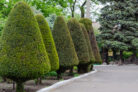
In geometry class, we learned that a pyramid has a square base and triangular sides that meet at a point. If the base is round, it’s technically a cone. Whatever you want to call it, the look is the same: a wide, lush base that tapers into a stunning flowering peak.
Climbing Supports
To get your Mandevilla to grow into that classic pyramid shape, it needs a trellis to act as its skeleton. The “base” of your pyramid is actually the soil surface in your pot, so the shape of the pot itself isn’t the most important factor. However, I think a Dipladenia pyramid looks most balanced when you use a round or square planter.
Choosing the Right Trellis
Basically, you can use any climbing support that can be anchored in the pot and angled to meet at a single point at the top.
Pre-made Pyramids
The easiest way? Buy a ready-made pyramid trellis and simply push it into the soil.
Bamboo Stakes
Creating a pyramid out of stakes is a great DIY option:
- Stick three (bamboo) stakes into the soil around the edge of the pot.
- Pull the tops together and tie them securely with twine.
Interlocking Trellises
An alternative to stakes is using interlocking trellises, the kind often used for tomatoes. To build your frame:
- Place two trellises opposite each other with plenty of space between them.
- Lean the tops toward each other so they stand at an angle.
- Interlock or tie them at the top.
Flat Trellises
A rectangular trellis is usually just a flat surface for the Mandevilla to wrap around. But, if you take two of them and lean them against each other so the top edges meet, you’ve got yourself a pyramid shape. For an even cleaner look, try using two fan-shaped trellises, since they naturally narrow toward the top.
Cones
Cone-shaped supports are “plug and play”—just stick them in the pot. The only downside is you can’t adjust the angle of the sides yourself. Keep an eye on the slope of the bars when you’re shopping to make sure it’s the look you want.
Obelisks
Obelisks are another easy “stick it in the pot” solution. Just a heads-up: since the stakes on an obelisk often don’t taper until the very top, your pyramid might end up looking more like a flowering pillar.
The Right Dipladenia Varieties
Picking the right trellis is only half the battle. The other half is choosing the right plant! Not all Mandevilla varieties grow those long, winding vines needed to cover a tall frame. If you want a vigorous climber for your balcony, look for these:
- “Agathe White”
- “Agathe Scarlet”
- Mandevilla x Rubiniana
Since the pyramid is such a popular look, you can often find Mandevilla already trained onto three bamboo stakes at the garden center. It’s almost impossible to untangle those vines without breaking them, so when it’s time to repot, just move the whole thing—stakes and all—into the new container. You can then place your own larger pyramid frame over the original one and guide the new growth onto it.