Ever wonder how old that majestic pear tree in your backyard actually is? Today, we’re diving into how to estimate a tree’s age, checking out some classic heirloom varieties, and taking a quick trip through the history of this garden favorite.
A Little Pear History
Pears are pome fruits and members of the rose family (Rosaceae). These trees can reach an impressive size of 50 to 65 feet. While hitting the 300-year mark is rare, it’s totally possible for a wild pear! However, most grafted garden varieties usually live to be about 70.
Pears likely made their way to Europe from China and Asia Minor. Today, you’ll find them growing everywhere from North Africa and Europe to Asia and Japan. Humans started breeding them early on—by the 17th century, there were already 250 known varieties. That number jumped to 900 in the 19th century, and today, there are roughly 5,000 different varieties worldwide.
Classic Heirloom Varieties
- Williams Christ (Bartlett) – A sweet, aromatic pear that’s delicious fresh off the tree or canned for later.
- Gellert’s Butter Pear (1820) – Known for being incredibly juicy; the trees are vigorous growers.
- Gute Luise (1788) – This one has a unique melon-like aroma and makes for an excellent dessert pear.
- Conference (1894) – A high-yielding, tasty variety that stores really well through the winter.
- Ulmer Butterbirne (1868) – A very frost-hardy variety that can handle higher elevations.
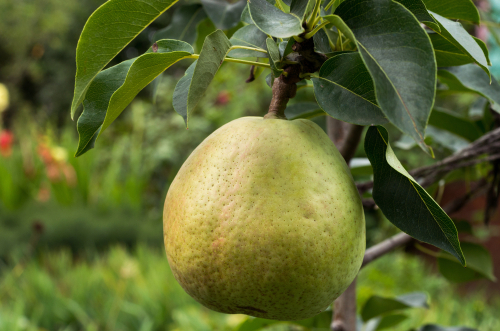
- Abate Fetel (1866) – Distinctive for its long, large, yellow-green fruits and sweet flavor.
- Alexander Lucas (1870) – A medium-sized fruit with smooth skin and a lovely, mild sweetness.
How to Tell How Old Your Pear Tree Is
If you’ve got an old pear tree in your yard, you can get a ballpark estimate of its age just by looking at it. If it’s towering over the garden, it’s likely a standard (full-size) tree and definitely isn’t a “youngster” anymore. Thick, rough bark and branches covered in moss are also classic signs of a senior tree. Lots of dry, dead wood in the canopy is another giveaway.
To get a more scientific estimate, you’ll need to measure the tree’s diameter and the thickness of the bark. You can find specific mathematical formulas online that use these measurements to calculate a very close age estimate without having to cut the tree down!
Caring for an Old Timer
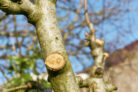
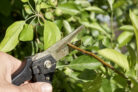
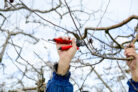
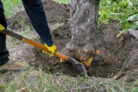
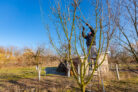
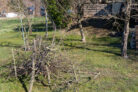
Older pear trees often end up with a lot of dead wood. Your first step should be to clear out any dead branches. You should also prune away the “suckers”—those little vertical shoots that often sprout around the base of the trunk. A good “rejuvenation prune” to reshape the crown can also breathe new life into an old tree.
Pro Tip: Since pear trees can get quite tall, I always recommend calling in a pro for heavy pruning. A certified arborist or a professional landscaping crew will have the right gear and the expertise to do the job safely and correctly.