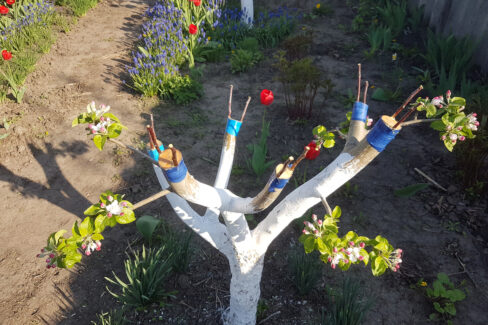
If you’ve been diving into the world of fruit tree propagation, you’ve probably run into some jargon like “rootstock,” “scion,” or “grafting.” It can sound a bit technical, but don’t worry—I’m here to break down exactly what these terms mean and why they matter for your home orchard.
The Basics: Scions and Rootstocks
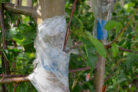
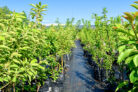
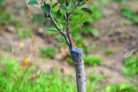
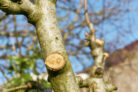
Here’s the thing about apple trees: you can’t just plant a seed or stick a cutting in the ground and expect a perfect tree. To get the exact variety you want, you have to use a process called grafting. This involves taking a “scion” (a bud or shoot from the variety you want to eat) and joining it onto a “rootstock” (the root system of a hardy, wilder relative). Once they grow together, you get a tree that combines the delicious fruit of the scion with the sturdy, reliable roots of the rootstock.
Why Should You Care About the Rootstock?
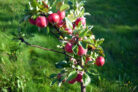
When you’re at the nursery, it’s easy to focus only on the type of apple—like a Honeycrisp or a Gala. But the rootstock is just as important! Think of the rootstock as the “engine” of the tree. It determines how fast the tree grows, how big it will eventually get, and how well it handles your specific soil.
Keep in mind that you can’t just mix and match anything; an apple scion needs an apple-related rootstock. You couldn’t graft a pear or a plum onto an apple root and expect it to last. Checking the rootstock before you buy ensures you won’t end up with a 25-foot giant in a tiny backyard!
Common Tree Forms
The shape and size of your tree are mostly defined by the height of the trunk and how the canopy is trained. Here are the most common forms you’ll see:
The Standard (High-Stem)
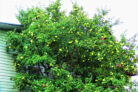
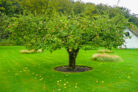
The Standard tree usually has a trunk height of about 6 feet (1.80m). These are grafted onto very vigorous rootstocks and are the classic, large trees you see in old-fashioned meadows.
The Semi-Standard (Half-Stem)
A Semi-Standard has a trunk height of about 4 feet (1.20m). Don’t let the name fool you—it’s not necessarily “half” the size of a standard! While the trunk is shorter, the canopy can still get quite large. Common rootstocks for these are M25 or A2, resulting in a tree that’s slightly more manageable than a full standard but still substantial.
The Spindle (Dwarf/Small Tree)
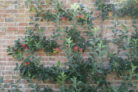
The Spindle is the go-to for modern backyard gardens, with a short trunk of only about 1.3 feet (0.40m). These trees usually top out at 6 to 10 feet high and wide. Depending on how you prune them, you can keep them quite narrow—some gardeners even plant them just 3 feet apart! The M26 rootstock is a popular “middle ground” here, fitting somewhere between a spindle and a bush tree. Just a heads-up: these smaller, weaker-growing combinations usually need a stake or support for their entire lives.
A Quick Guide to Rootstocks
When you’re looking at labels, here’s a “cheat sheet” for the growth vigor:
- Dwarf/Slow Growing: M9 and M26 (Perfect for Spindles)
- Semi-Vigorous: M106, M7, and M4 (Great for Bush trees)
- Vigorous/Fast Growing: M25 and A2 (Best for large Standard trees)