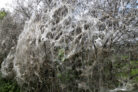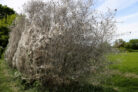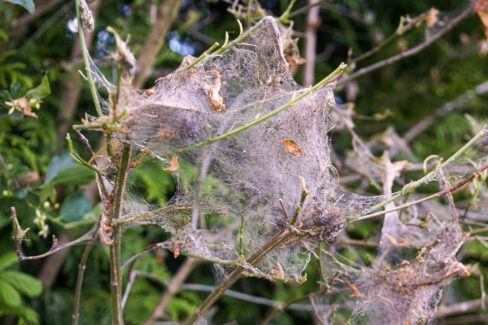
Every spring, you might spot something a little spooky in your garden: a Spindle tree (Euonymus) completely stripped of its leaves and draped in a thick, ghostly white web. It looks like a prop from a horror movie, doesn’t it? But don’t panic! There’s a perfectly natural explanation for this eerie makeover.
Meet the Spindle Ermine Moth
That white webbing is the handiwork of the Spindle Ermine Moth (*Yponomeuta irrorella*). These tiny moths are actually quite delicate-looking once they mature. Here’s how you can identify them:
- They have a wingspan of about 18 to 24 mm.
- Their heads and antennae are pure white.
- The thorax is white, and the scales where the wings attach are white with tiny black dots.
- The hindwings are a brownish-gray.
- Their legs and abdomen also sport a gray-brown hue.
- The undersides of the forewings are gray-brown, while the tops are snowy white.
- Most distinctively, the tops of the wings feature three neat rows of black dots.
The Life Cycle of the Moth
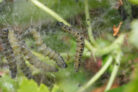
The cycle begins when the female lays her eggs on the bark, covering them with a special secretion that hardens into a protective shield. This “winter coat” keeps the eggs safe until spring. Once the weather warms up, tiny caterpillars hatch and immediately start feasting on the fresh spring leaves. These little guys are social butterflies—or moths, rather—and work together to spin silk around withered leaves, creating cozy communal “tents.” These webs aren’t just for show; they protect the larvae from bad weather and hungry predators.
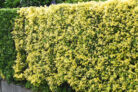
If you have a major infestation, the caterpillars can eat every single leaf on the bush. A few days before they’re ready to pupate (usually between June and July), they stop eating. Once they turn into pupae, the “haunting” is basically over. It takes about 10 to 20 days for the moths to emerge. Eventually, the rain washes away the old webs, and the Spindle tree bounces back, putting out a fresh flush of leaves as if nothing ever happened.
The adult moths fly around in July and August, find a mate, and the females lay their eggs back on a Spindle tree to start the whole process over again next year.
How to Manage an Infestation
The good news is that Spindle trees are tough and usually survive these attacks just fine. Because of this, most gardeners don’t even notice the moths until the tree is already covered in silk. At that point, spraying pesticides is pretty much useless because the thick webbing acts like a raincoat, preventing the spray from ever reaching the caterpillars. If you happen to catch them early, you can use products based on *Bacillus thuringiensis* (Bt), which is effective and bee-friendly.
The best way to handle them is to be proactive:
- Winter Check: Inspect your shrubs before winter and scrape off any egg masses you find.
- Spring Pruning: In early spring, keep an eye out for the first signs of wilting leaf tips. Snip those off and toss them in the trash (not the compost!) to stop the spread.
- Web Removal: As soon as you see those first silky webs appearing, prune those branches out immediately and dispose of them.