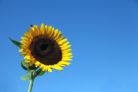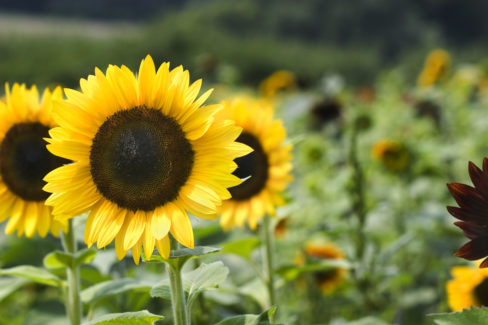
As soon as those bright yellow petals pop, they steal the show. It’s easy to get so distracted by their beauty that we forget about the rest of the plant! But since no flower can survive on looks alone, let’s take a closer look at what makes a sunflower tick.
The Anatomy of a Mature Sunflower
- Roots
- Stem
- Leaves
- Flower Head
If you skip the deadheading and leave the spent flower heads alone, you’ll also see those famous seeds ripening by the time fall rolls around.
Quick Tip:
Want the full scoop? Check out our detailed sunflower profile for more facts.
The Roots
Without roots, this plant wouldn’t stand a chance. Since they’re hidden underground, they don’t get much credit, but every gardener should know that sunflowers love to spread their “toes.” The more room the roots have to roam, the healthier the plant will be—and the bigger the bloom! If you’re growing sunflowers on a balcony, make sure to plant them in a pot that is both wide and deep.
Quick Tip:
When fall arrives, cut back the stalks but leave the roots in the dirt. As they decompose, they actually improve the soil quality, making it the perfect spot to sow sunflower seeds again next year.
The Stem
Depending on what you plant, the stem can vary wildly. Dwarf varieties might only reach 15 inches, while the giants of the family can tower up to 10 feet high with stems several inches thick. Even so, they can be a bit top-heavy. It’s best to plant them in a spot sheltered from the wind or give them some extra support by tying them to a sturdy stake.
If you look closely, you’ll notice the stem is covered in countless tiny, bristly hairs.
The Leaves
Sunflower leaves are large, heart-shaped, and grow in an alternating pattern up the stem. Just like the flowers, young leaves will actually track the sun throughout the day. In the gardening world, we call this “heliotropism.”
The Flower Head
The blooming season usually kicks off in June and can last through late October. Some varieties produce just one massive “king” bloom, while others branch out to show off multiple flowers. What we call a “flower” is actually a complex head made of several parts:
- Tiny tubular “disk florets” fill the center of the head.
- These are arranged in a spiral and are usually brown.
- These florets are what eventually turn into seeds.
- The bright petals around the edge are called “ray florets.”
- While usually yellow, they can also be red or orange (like the Evening Sun variety).
That spiral pattern in the center isn’t just pretty—it’s a mathematical marvel known as the “Golden Angle.” It ensures that every single floret gets the maximum amount of sunlight possible!