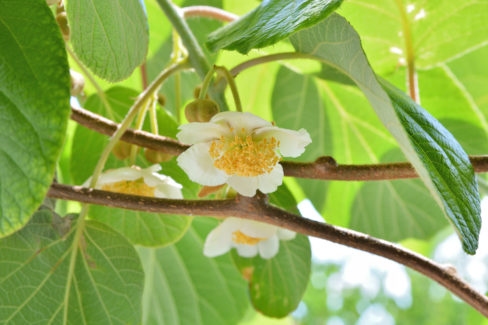
Once a year, the kiwi plant puts on a spectacular show when its creamy white blossoms finally open. These flowers aren’t just a treat for the eyes—measuring about 2 inches across—they also fill the air with an incredible, sweet fragrance.
Spotting the Signs: Kiwi Flower Characteristics
Kiwi flowers are large and wheel-shaped, usually starting to bud in March and reaching full bloom between June and July. As the season progresses, you’ll notice the petals transition from a snowy white to a soft yellowish hue along the edges. At the center, you’ll find a cluster of tiny, golden-yellow stamens that give the flower its exotic look.
If you’re hoping for a harvest, it’s important to know that male kiwi plants produce flowers but won’t grow any fruit. The female plants are the ones that provide the actual kiwis after the blooming phase. You can actually tell the difference just by looking at the blooms: female flowers have a distinct white pistil (the center part) surrounded by yellow stamens. Male flowers, on the other hand, lack that central pistil and only feature the stamens and white petals.
When Do Kiwis Bloom?
Patience is key with these vines! If you’ve grown a kiwi plant from scratch, it can take ten years or even longer to see that first blossom. However, if you buy grafted kiwi shrubs from a local nursery, you’re in luck—they usually start blooming by their third year in the ground.
Once your plant has matured enough to flower, it will consistently hit its peak bloom every year in early June. Just keep in mind that how much fruit you get depends on a few big factors:
- The location and soil quality
- Your pruning and maintenance routine
- Proper watering and nutrient supply
- The general climate and weather conditions in your area
The Secret to Pollination
To get a bountiful harvest, your female plant needs a male neighbor nearby. Kiwis are “dioecious,” which is just a fancy botanical way of saying that male and female flowers grow on separate plants. Without a male plant to provide pollen, the female flowers won’t develop into fruit.
If you’re planning your garden, the rule of thumb is to always include at least one male plant—the cool thing is that one male can pollinate several female shrubs! If you’re short on space, you can also look for “self-fertile” varieties. These have hermaphroditic flowers (containing both male and female parts), meaning they can pollinate themselves without needing a partner.