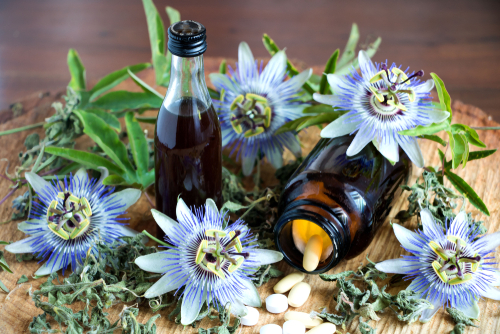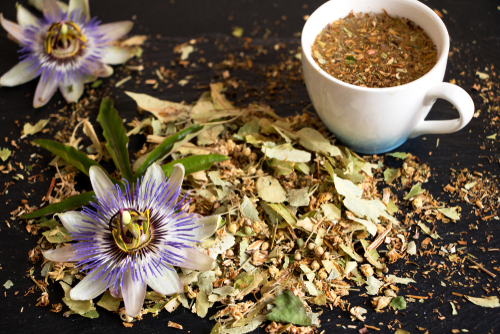
With over 500 species to its name, the passionflower calls Central and South America home. These stunning vines didn’t make their way to Europe until the 16th century, where they were grown strictly as ornamental garden beauties for hundreds of years. It wasn’t until the 20th century—when people started looking back toward alternative medicine—that the passionflower was “rediscovered” for its incredible healing potential.
An Herb for Inner Peace
In the world of natural health, passionflower is used as a classic medicinal herb. This means that every part of the plant above the ground is used (everything except the roots). You’ll usually find it sold in its dried form as “passionflower herb.” It’s a go-to remedy for a few specific issues:
- Nervous restlessness and jitters
- Trouble falling or staying asleep
- Relieving anxiety and muscle tension
A Scientific Mystery
Here’s the kicker: while science has confirmed that drinking passionflower tea or taking it in tablet form actually works, researchers are still scratching their heads over *why*. We know the healing effects are real, but the exact “how” is still a bit of a mystery. The plant is packed with flavonoids, which are famous in the natural health world for their antioxidant properties. In passionflower, these mostly show up as C-glycosides, which seem to be the secret sauce behind its calming effect.
Passionflower in Homeopathy
Because it’s a pure, natural remedy, passionflower is also a staple in homeopathy, often found as *Passiflora incarnata* globules. Since it was recognized as a medicinal herb relatively late in European history, it was easily integrated into homeopathic practices. Just like in traditional herbalism, homeopathic Passiflora is used to soothe nerves and the physical symptoms that come with stress. It’s also used for emotional exhaustion or to help the body recover after a long illness. You can find these globules in various potencies depending on what you need.
A Team Player in Supplements
While you’ll find passionflower as a standalone remedy in homeopathy, it usually plays the role of a “team player” in standard herbal medicine. It’s most commonly found in combination formulas alongside other heavy-hitting calming herbs like valerian root, St. John’s Wort, or hops. Finding pure passionflower extract on its own is actually a bit less common!
A Medicine with Deep Roots
Even though Europeans were late to the party, the Indigenous peoples of South and Central America had been using passionflower as medicine long before Columbus ever set sail. Interestingly, they focused heavily on the roots. For example, the Houma people (from what is now the Southern U.S.) used root infusions as a blood tonic. The Cherokee used a tea made from the roots to help wean babies, and several other tribes used root preparations to soothe earaches.
A New World Classic
Many of these traditional uses were actually picked up by early American settlers and colonists, even though the news didn’t travel back to the medical circles in Europe right away. As early as 1570, Francisco Hernandez wrote about the calming properties of the plant in his descriptions of New World medicinal plants. Later, in 1787, the German naturalist Johann David Schöpf mentioned passionflower in his “Materia Medica Americana” as a potential treatment for epilepsy in older adults.
A Multi-Faceted Herb
As you can see, the passionflower has a long, colorful history as a healer. Even if science hasn’t quite mapped out every single detail of how it interacts with our brains, one thing is for sure: if you’re struggling with anxiety or tossing and turning at night, this beautiful vine might be exactly what you need to find your zen.