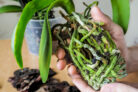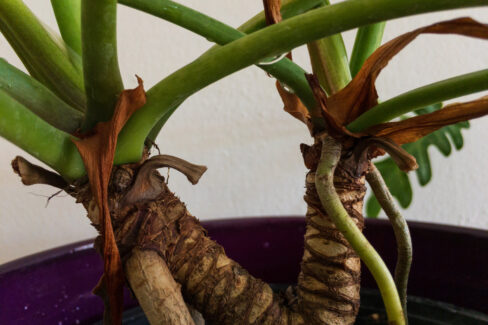
All climbing Philodendron varieties come equipped with a dual root system: soil roots and aerial roots. While the soil roots do the heavy lifting by stabilizing the plant and soaking up nutrients and water from the ground, those funky-looking aerial roots play a huge role too. In this guide, I’ll break down exactly why they’re so important:
Aerial Roots: More Than Just Decoration
As soon as a climbing Philodendron starts reaching for the sky, you’ll notice aerial roots sprouting from the leaf nodes along the stems. Along with the exotic Philodendron fruit, these “air roots” are a signature feature of the plant. In their natural habitat—the tropical rainforest—Philodendrons use these roots to wrap around massive trees, helping them hitch a ride up toward the sunlight.
Because they don’t actually harm the host tree (they aren’t parasites!), the Philodendron earned the nickname “Tree Friend.” Plus, these roots are covered in tiny structures that act like sponges, absorbing moisture and nutrients directly from the rain and the humid jungle air.
How to Care for Your Plant’s Aerial Roots
If you want your Philodendron to look lush and vibrant, you can’t ignore those air roots. Here are a few pro-tips for your care routine:
- Mist the aerial roots with soft water (like filtered or rainwater) up to twice a week.
- Never cut off long, healthy root strands just because they look messy.
- Instead, gently guide them toward a trellis or support pole.
Of course, when you’re doing your regular pruning, it’s totally fine to remove the aerial roots attached to the stems you’re cutting. Otherwise, you should only trim them back if they have completely dried out or died.
Give Those Roots Something to Grab On To
Aerial roots aren’t big fans of smooth surfaces; they want something that feels like tree bark. That’s why moss poles or coco coir poles make the best supports. Even with a textured surface, though, sometimes the roots need a little encouragement to latch on.
Here’s a trick to get them established:
- Wrap your support pole in a layer of Sphagnum moss (about 2 inches thick).
- Loosely tie the aerial roots against the moss.
- Mist the moss daily with soft water.
Once they sense that damp moss, the roots will eventually anchor themselves so firmly that you won’t even need ties anymore!