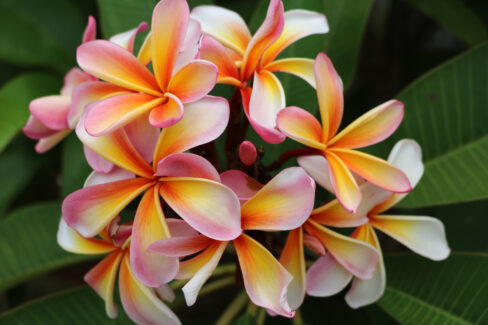
Unfortunately, even the most beautiful Frangipani (Plumeria) isn’t immune to uninvited guests. The amount of damage these pests can do really depends on which one has decided to move in. My best advice? Keep a close eye on your plants and do regular “check-ups.” If you spot something, act fast before a few bugs turn into a full-blown infestation!
Common Pests
The usual suspects you’ll find hanging out on your Plumeria include:
- Aphids
- Whiteflies
- Thrips
- Spider Mites
Aphids
Aphids are pretty common and relatively easy to handle if you catch them early. However, they multiply like crazy, so don’t let them get too comfortable.
- Appearance: Tiny (just a few millimeters), usually green, brown, or black.
- Where to look: Check the flower buds and the tender new growth at the tips.
- When they show up: Year-round.
- Signs of trouble: You’ll see visible clusters of bugs. You might also notice a sticky, clear film on the leaves (that’s “honeydew”). If you see ants marching up and down the stems or other flying insects hanging around, they’re likely there to snack on that sticky residue.
What to do
- Squish individual bugs by hand.
- Give the plant a good spray-down with the hose or in the shower.
- Prune off any heavily infested parts.
Whiteflies
“Whitefly” is actually a catch-all name for several species of white-winged scale insects. Your Frangipani can usually handle a few of them, but a major infestation can really stress the plant out.
- Appearance: About 1.5 millimeters long, snowy white.
- Where to look: Anywhere above ground, including the blooms.
- When they show up: Year-round.
- Signs of trouble: Sticky honeydew on the leaves and tiny white dots (eggs) laid in circles on the undersides of leaves. A dead giveaway? A cloud of tiny white “moths” flying up when you touch the plant.
Treatment and Prevention
- Use yellow sticky traps.
- Rinse the plant thoroughly.
- Remove any leaves that are covered in eggs.
- Use Neem oil-based sprays.
- Prevention: Unfortunately, there’s no real way to prevent them—just stay vigilant!
Spider Mites
Spider mites are the ultimate garden villains. They work fast, do a lot of damage, and are notoriously hard to get rid of. Just when you think you’ve won, they often pop back up a few weeks later.
- Appearance: Microscopic (0.3 to 0.6 mm), yellowish to reddish-brown.
- Where to look: On the undersides of the leaves.
- When they show up: Year-round, especially in dry, warm conditions.
- Signs of trouble: Leaves will look speckled with yellow, eventually turning silvery. The classic sign is fine, delicate webbing with tiny white dots caught in it.
What to do
- Isolate your Plumeria immediately so they don’t spread.
- Give the plant a heavy pruning, cutting back infested areas generously.
- Crank up the humidity! Mist your plant regularly or use a humidifier, as these guys hate moisture.
Thrips
Thrips might be even more annoying than spider mites because they are incredibly fast and hard to catch.
- Appearance: 1 to 2 millimeters long, slender, and brown or black.
- Where to look: Usually hiding on the undersides of leaves.
- When they show up: Year-round, especially when it’s warm and dry.
- Signs of trouble: Yellow speckled leaves that eventually take on a silvery sheen. Look for tiny black spots (fecal droppings) and “cork-like” scarred spots where they’ve been feeding.
What to do
- Isolate the plant right away.
- Prune back damaged parts aggressively.
- Increase the humidity (misting is your friend) and use blue sticky traps in the pot to catch the adults.