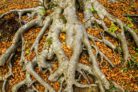
Most maple species are what we call shallow-rooted trees. If you’ve ever had to say goodbye to a maple in your yard, you probably realized pretty quickly what that means! Even after the tree is gone, that prime garden real estate is basically off-limits for new plants until those stubborn roots are either dug out or fully decomposed.
Why those roots have to go
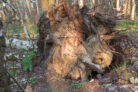
When a maple is cut down—maybe because it’s dealing with a nasty fungal infection—you’re left with a visible stump. But underground, the entire root system is still hanging out, completely intact. Since maples are usually shallow-rooted, they create a dense network right in the top layer of soil, making it nearly impossible to plant anything else there. Plus, if you leave the stump alone, you’ll likely see new shoots trying to pop back up.
Quick Tip:
If you grow a maple in a pot, you’ll never have to worry about the headache of removing roots from your landscape later on!
How to remove roots after felling
If your maple’s trunk is less than 12 inches (30 cm) in diameter, you can usually tackle the root removal yourself. Just a heads-up: don’t underestimate the job! It’s a serious workout and takes some real elbow grease. Here’s how to make the process a bit easier:
- Leave about 3 to 5 feet of the stump standing (don’t cut it flush yet!).
- Use a spade to expose as much of the root system as possible.
- Snip smaller roots with loppers.
- Use an axe to chop through the thicker, tougher roots.
- Now, use that long stump for leverage—push and pull it back and forth with all your might.
- If you have access to a truck or a tractor, use it to help pull.
- Once it’s loose, haul the stump and the attached roots out of the ground.
Note:
If your tree was suffering from Verticillium wilt, you need to act fast. Not only should you grub out the roots immediately, but you should also swap out the surrounding soil, as this disease is highly contagious to other plants.
Speeding up the rotting process
If digging sounds like too much work, there’s a “lazy” way to handle it. It requires very little physical effort, though you’ll need to be patient—it usually takes about 6 to 12 months for the wood to break down.
- Use a chainsaw to cut a crosshatch pattern deep into the stump at ground level.
- Alternatively, drill several deep holes into the wood using a large drill bit.
- Fill these gaps or holes with fresh compost.
- Add some compost starter (accelerator) to the mix.
The microorganisms in the compost will get to work eating away at the wood. Once it’s softened up, you can easily break apart the remains and clear the area.
Cutting back individual roots
Sometimes you want to keep the tree, but a few rogue roots are starting to cause trouble (like lifting a sidewalk or encroaching on a flower bed). You can trim these back, just be sure to use sharp, clean tools to ensure the tree stays healthy and doesn’t get infected.
Quick Tip:
To save yourself from “wandering root” frustration down the road, consider installing a root barrier when planting your maple. It should be at least 20 inches deep, stick up about 4 inches above the soil, and be made of a sturdy material at least 2mm thick.