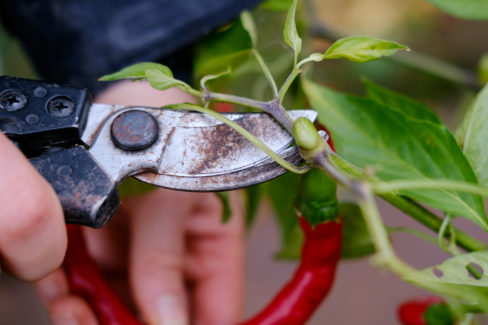
Most gardeners don’t think about pruning their hot peppers, but taking those shears to your plants can actually be a game-changer for your harvest. That said, you don’t want to go in hacking blindly—you need a strategy so you don’t accidentally snip off your best producers.
Taming the Height
Some pepper varieties love to shoot straight up toward the sky, leaving you with a tall, lanky plant and very few side branches. This isn’t just a stability issue (nobody wants a plant that flops over without a stake); it also means fewer branches to hold fruit.
If your peppers are looking a bit too “leggy,” it’s time to pinch them back. Trim the longest stems down by about an inch or two (3-5 cm). Ideally, you want to keep the plant around 12 inches (30 cm) tall to encourage it to bush out. Once you top those tall stems, the plant usually responds by pushing out a ton of new side growth.
Boosting Your Yield
Not all branches are created equal. Sometimes, a plant gets so crowded that the branches actually get in each other’s way, blocking airflow and light. This slows down ripening and tells the plant to stop producing new flowers. To fix this, focus on keeping a few strong, sturdy main branches and prune away the weak, spindly ones that pop up during the growing season.
Focusing on the “heavy hitters” is also a safety measure. If a plant is loaded with fruit, those weak branches can snap under the weight. If you do have to cut a weak branch that already has peppers on it, don’t let them go to waste! You can harvest those peppers green and use them right away for pickling or fresh salsas.
Speeding Up the Ripening Process
Pruning is also a great trick for getting your peppers to ripen faster. By removing extra foliage and new flowers, the plant can funnel all its energy into the fruit that’s already there. Around mid-August, any new flowers that pop up probably won’t have enough time to turn into fully ripe peppers before the first frost, so it’s best to snip them off.
You should also trim back any branches that aren’t currently holding fruit to about an inch (3 cm). This thins out the canopy and lets more sunlight hit the remaining peppers, which acts like a “fast-forward” button for ripening.
Pruning for Overwintering
Even though there are differences between various hot peppers and jalapeños, they all share one cool trait: they’re actually perennials! If you bring your plants inside for the winter, you’ll get a massive head start and a much earlier harvest next year.
To prep them for their winter nap, you’ll want to cut the plant back by at least two-thirds. You can even strip off the remaining leaves while you’re at it. Since indoor light is much weaker than the summer sun, the plant is likely going to drop those leaves anyway, so this just keeps things tidy.