Since most of our exotic orchids live their best lives as houseplants, getting them pollinated naturally is pretty much a long shot. Unless you’re growing your orchids outdoors where the local bugs can do the heavy lifting, you’re going to have to play “the bee” yourself if you want to grow them from seed.
What You’ll Need to Get Started
Before you grab your tools, there are a few ground rules for a successful hand-pollination:
- You need two separate orchid plants; they don’t necessarily have to be the same species, but they do need to be two distinct plants.
- Both orchids should be strong, healthy, and full of life.
- Each plant should have at least two fully opened flowers.
Hybrids and Cross-Breeding
If you use pollen from two orchids of the same species, you’ll get stable hybrids. But if you’re feeling adventurous and cross two different species, you might end up with some really unique, unpredictable intergeneric hybrids!
How to Hand-Pollinate Like a Pro
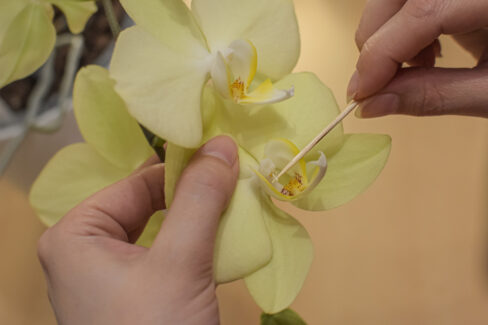
The orchid’s pollen is tucked away behind a little “cap” called the anther cap, which protects the pollinia (pollen masses). To get to the goods, you’ll need to remove this cap—a simple toothpick is your best friend here.
Look for pollen that is a bright, golden yellow. If it looks dark or brownish, it’s likely past its prime and probably won’t be viable for fertilization.
Once you’ve opened the cap, here’s the step-by-step:
- Use your toothpick to gently pick up the golden-yellow pollen.
- Check the flower you want to fertilize. If the stigma (the female part) is covered by a “lip” or pouch, you’ll need to gently move it aside to reach the opening.
- Carefully place the pollen onto the sticky surface of the stigma on the receiving flower.
Signs of Success
If you did it right, you’ll notice the stigma starting to close up and swell slightly. If nothing changes, the pollination likely didn’t take, and you might want to try again.
A successfully fertilized flower will actually wither away within a few days—don’t worry, that’s a good thing! Over the next few weeks, the pollen travels down to the ovary, where the real magic happens. It takes about nine months for the seeds to fully ripen inside the seed pods. Once they’re ready, you can start the exciting process of sowing them.
A Note on “Inbreeding”
Orchids are pretty smart—they generally won’t pollinate themselves. To get viable seeds, you really do need two different flowers from two different plants. Most orchid species have built-in mechanisms to prevent self-pollination. If you try to pollinate a flower with its own pollen, you’ll usually just end up with empty seed pods that won’t grow into anything.