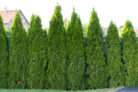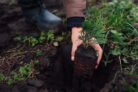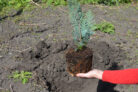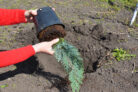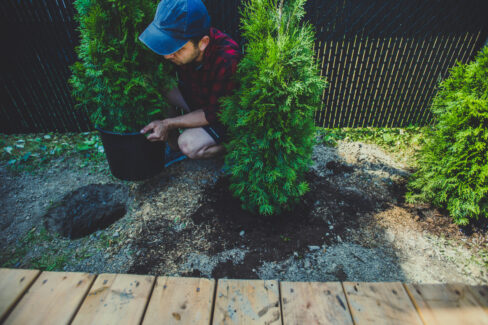
Whether you’re looking to build a lush privacy screen or just want to plant a single Thuja (Arborvitae) as a focal point, getting the spacing right is key. How far apart these evergreens should be depends on a few different factors, and getting it right from the start will save you a lot of headaches later!
What should you consider when spacing your Thuja?
Proper spacing isn’t just about making sure your Thuja looks good as it grows. You also need to protect nearby structures from root growth and stay on the right side of local property laws. Before you start digging, keep these factors in mind:
- Whether you’re planting a hedge or a single tree
- Proximity to roads and sidewalks
- Distance from patios or concrete slabs
- Location of utility lines
- Property lines and neighborly boundaries
Arborvitae come in all shapes and sizes. Some varieties can tower over 15 feet tall, while others stay a compact 3 feet. Because of this, the specific variety you choose will play a huge role in how much breathing room it needs.
How much space does a Thuja need from other plants?
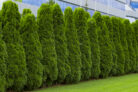
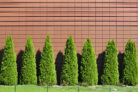
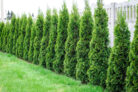
If you’re planting a single Thuja as a standalone specimen, giving it about 3 feet of space from other plants is usually plenty. However, if you’re planting a hedge, the spacing depends entirely on the variety. For many popular types, like the Thuja ‘Brabant’, 15 to 24 inches apart is the sweet spot. On the other hand, a Thuja ‘Smaragd’ (Emerald Green) needs a bit more room—at least 24 inches, though 30 inches is even better for long-term health.
If you crowd them too much, the roots will end up competing for water and nutrients. It’s only a matter of time before you see brown tips, and you might even find your beautiful new hedge dying off in patches. You can avoid those unsightly gaps by simply giving the plants enough space to breathe from day one.
How far should an Arborvitae be from property lines and structures?
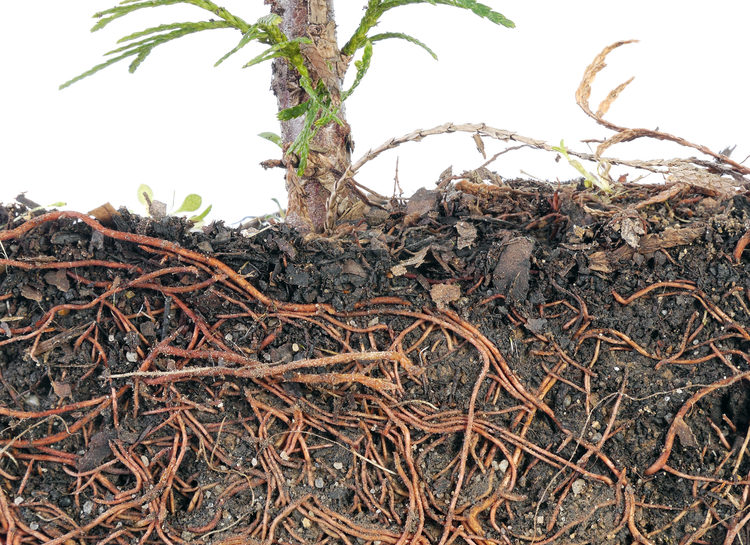
Since Thujas are shallow-rooted trees, they aren’t usually a big threat to deep utility lines. However, they can definitely mess with sidewalks, driveways, or nearby garden beds as the roots spread out. A good rule of thumb is to let the expected final height of your hedge dictate how far back you plant it from structures.
Don’t forget about your neighbors! Most local municipalities have specific rules about how close you can plant to a property line. In many areas, the rule is that a tree should be planted as far from the boundary as its eventual height. It’s always a smart move to check with your local city hall or HOA first. If you skip this step, you might find yourself in a situation where the city or a neighbor legally requires you to remove your hard work.