Hydrangeas are generally known for being pretty tough customers in the garden, and they don’t usually get hit by fungal issues too often. But every now and then, things go sideways. If your plants start looking a little funky, you can usually spot a fungal infection by some very specific warning signs. Here’s a breakdown of what to look for and, more importantly, how to fix it so your hydrangeas stay happy and healthy.
The most common culprits are:
- Powdery and Downy Mildew
- Gray Mold (Botrytis)
- Leaf Spot Disease
Spotting and Treating Mildew
When the weather gets warm and humid, fungus loves to move in. Hydrangeas are particularly susceptible to two types: Powdery Mildew and Downy Mildew. With Powdery Mildew, you’ll see a white, fuzzy coating on the leaves—it literally looks like someone dusted them with flour. Eventually, the leaf tissue dies off, and the leaves wither and drop.
Downy Mildew, on the other hand, hides out on the undersides of the leaves as a grayish-white film. Later on, you might notice dark or yellow spots appearing on the tops of the leaves. Keep a close eye out! Any weird change in your leaves is usually your plant’s way of screaming for help.
How to handle it:
- Snip off the affected parts and toss them in a sealed trash bag (don’t compost them!).
- For Powdery Mildew, try spraying the plant with a silica-based solution.
- For Downy Mildew, a garlic spray/infusion is a great natural remedy.
Dealing with Gray Mold (Botrytis)
Gray mold is a bit more aggressive. It covers both the leaves and the flowers in a thick, dark gray fuzzy coating—much thicker than mildew. If left alone, it can cause the hydrangea’s new shoots to become stunted or die back. To save your plant, you’ll want to jump on this quickly.
How to fight Gray Mold:
- Be ruthless! Prune away any infected shoots and get them into a sealed trash bin immediately.
- Thin out the plant to improve airflow so moisture can evaporate faster.
- Water your hydrangeas in the morning. Always aim for the base of the plant and avoid getting the leaves wet.
Managing Leaf Spot Disease
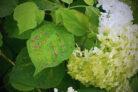
Leaf spot usually shows up when your hydrangea is feeling a bit “run down” due to poor nutrients combined with high humidity. You’ll notice brown spots forming on the leaves that get darker toward the center. Eventually, the tissue in those spots dies out completely.
How to treat affected hydrangeas:
- Cut off the spotted leaves and dispose of them in a sealed bag.
- Give your hydrangea some fertilizer to make sure it has the nutrients it needs to stay strong.
- If the infection is really taking over, you might need to step in with a fungicide.