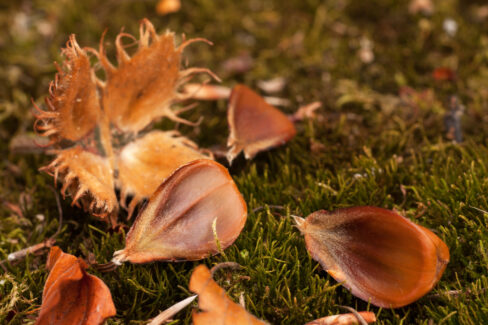
To reproduce, beech trees need seeds, which means they have to grow fruit. If you’ve ever taken a stroll through a beech forest in the fall, you’ve probably seen them scattered all over the ground—little brown nuggets blending right in with the fallen leaves. These are what we call beechnuts.
How to Spot the Fruit
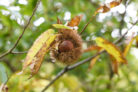
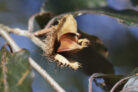
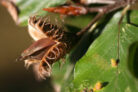
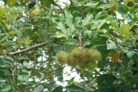
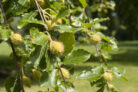
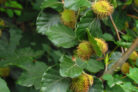
When spring rolls around, beech trees produce both male and female flowers. The female flowers grow in small clusters of two or three, tucked inside a four-lobed capsule. Once they’re pollinated, this capsule closes up tight so the seeds (the nuts) can ripen safely inside. By September, once they’re fully mature, the capsules drop to the ground and pop open to reveal the beechnuts:
- The outer hull (capsule) is about 1 to 3 inches long.
- It hangs from a short stem, has four lobes, and is covered in soft, prickly spines.
- Beechnuts themselves have a dark brown, shiny shell.
- They are egg-shaped but have three very distinct, sharp edges.
- Each nut is roughly half an inch long.
Maturity and “Mast Years”
In the world of botany, there are two interesting terms to know when it comes to beech trees: sexual maturity and mast years. “Maturity” is simply the age at which a tree is capable of producing fruit. For a beech tree, this starts around 10 to 15 years old, but it usually takes until the tree is between 40 and 80 years old before it produces high-quality seeds that can actually grow into new trees.
Beech trees don’t produce the same amount of nuts every year. A “mast year” is when the trees go into overdrive and produce a massive surplus of seeds. Historically, these were the years farmers would drive their pigs into the woods to fatten them up on the nuts (hence the term “mast”). These bumper crops usually happen every five to eight years. In the years between, the tree produces much less, and some years it might not produce any fruit at all.
How They Spread
Squirrels and birds love beechnuts and often carry them off to hide for later. This is nature’s way of planting; many of those forgotten seeds end up in a nice patch of soil. If the conditions are right, they’ll germinate and grow into saplings.
Pro Tip:
If you gather a few beechnuts in the fall, you can easily propagate your own beech trees at home come springtime.
Are Beechnuts Edible? (Yes, but with a catch!)
Beechnuts are small, but since they’re so plentiful, they’re easy to harvest in bulk. Just a heads-up: raw beechnuts contain compounds that are slightly toxic to humans. Eating a couple of raw nuts won’t hurt you, but if you want to eat them in larger quantities, you should soak and roast them first. Once roasted, they’re great for snacking or tossing into a salad. You can even grind them up as a coffee substitute or a flour alternative. By the way, beech leaves are edible too!