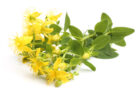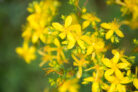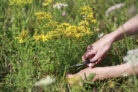
St. John’s Wort is famous for its brilliant yellow blooms, but let’s be honest—there are a lot of yellow wildflowers out there! While those sunny petals are a great first clue, you’ll need to look a little closer to be 100% sure of what you’ve found. Proper identification is a must-have skill so you don’t accidentally end up with something toxic in your harvest basket.
The Leaves: Simple but Secretive
At first glance, the leaves of Common St. John’s Wort (*Hypericum perforatum*) look pretty standard. But if you pay attention to the details—and especially if you hold them up to the sky—they tell a different story.
- Placement: Leaves grow in opposite pairs along the stem.
- Spacing: You’ll usually find a pair every half-inch to an inch.
- Attachment: They sit directly on the stem (no little leaf stalks here!).
- Shape: Oval to oblong with rounded tips.
- Size: Usually about 1/2 to 1 inch long.
- Texture: Smooth, thin, and hairless with “entire” (smooth) edges.
- Color: A nice, healthy medium green.
The Pro Tip: Hold a leaf up to the light. You’ll see tons of tiny translucent dots that look like pinpricks (that’s where the name *perforatum* comes from!). You might also see tiny black dots along the edges. These are actually glands filled with essential oils.
Yellow on the Outside, “Red” on the Inside
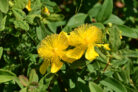
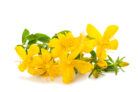
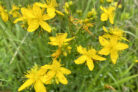
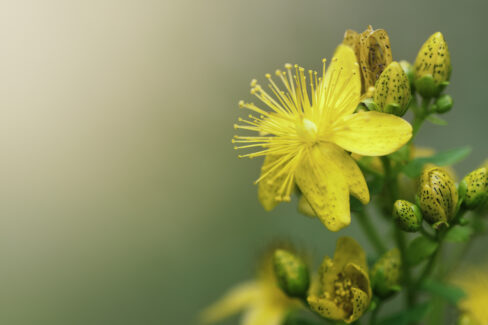
The flowers cluster at the top of the stems. Because the stems branch out so much at the peak, you get a massive splash of color. During the blooming season (typically late June through August), these golden-yellow clusters are hard to miss.
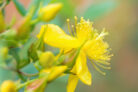
- The flowers are wide open and star-shaped.
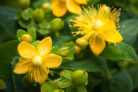
- They have five petals (about 15mm long) and five smaller sepals.
- Each flower is packed with up to 100 stamens, which gives them a fuzzy, shimmering look.
Quick Field Test:
Want to be absolutely sure? Pick a few petals and crush them between your fingers. If it’s true St. John’s Wort, your skin will be stained a deep reddish-purple. That’s the hypericin (the active compound) doing its thing!
What About the Fruit?
Since most people harvest St. John’s Wort while it’s in full bloom, the fruit isn’t usually the best way to identify it in the moment. Common St. John’s Wort eventually develops oval-shaped seed capsules that hold the seeds. Other ornamental varieties might produce smooth, round berries that turn shades of red, brown, or black as they ripen.
Don’t Get Tricked!
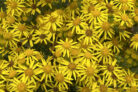
If you’re new to foraging, be extra careful not to confuse St. John’s Wort with Tansy or, more dangerously, Tansy Ragwort (Jakobskreuzkraut). Ragwort also blooms yellow in the summer, but it is toxic to humans and livestock. Always double-check your leaf patterns and do the “crush test” on the petals to stay safe!