No, I’m not talking about actual snow here. Real snowflakes are just part of nature’s winter charm and won’t bother a hardy boxwood one bit. But if you start seeing white flakes in the spring—long after the sun has started warming things up—you’re looking at something else entirely. Depending on what they are, they might be totally harmless, or they could be a sign that your boxwood is in trouble.
Boxwood Psyllids
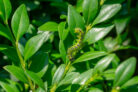
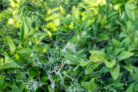
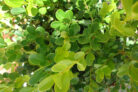
These little pests are often called “boxwood suckers,” and for good reason. They love to hang out on young leaves and fresh new growth. As they feed on the plant’s juices, they cause the leaves to curl up and deform, looking a bit like tiny green spoons. To protect themselves, these psyllids secrete white, waxy filaments that look like white flakes or tufts from a distance. If you look closely, you’ll find the yellowish-brown insects hiding inside. A heavy infestation also leads to sticky leaves; this “honeydew” they leave behind can lead to sooty mold, which shows up as a blackish coating on the foliage.
How to handle them
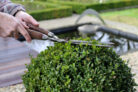
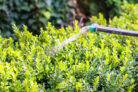
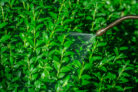
Adult psyllids lay their eggs on the boxwood in late summer. Once the larvae hatch, they hunkers down for the winter right on the plant, ready to start their mischief the following spring. The best way to get ahead of them is a light pruning in the summer to remove the eggs and larvae. You don’t need to do a massive chop—just trimming the tips of the shoots is usually enough. Just be sure to use disinfected shears (and clean them again afterward) so you don’t accidentally spread any fungi. Afterward, you can spray the plant with a neem or rapeseed oil-based treatment. Make sure to get the entire shrub dripping wet with the solution.
Pro Tip:
If your boxwood is in a very sunny spot, give it some temporary shade after spraying so the oil doesn’t cause the leaves to sunburn.
Mealybugs and Scale
Mealybugs cover leaves and stems in white, cottony webs, especially on the undersides of leaves and where branches fork. They can even spread down to the roots. Those white flakes are actually protective cocoons that keep them safe from predators. These tiny pests (about 3 to 7 mm long) suck the sap right out of the plant, which can really do a number on your boxwood:
- Leaves turn yellow and dry out
- Eventually, the plant starts dropping leaves
- Shoots and leaves become stunted or deformed
- Overall growth is stalled
How to handle them
If you catch them early, a neem or rapeseed oil spray is your best bet. However, if the infestation has really taken hold, you’ll likely need to prune it back. Be bold and remove any heavily infested branches, then dispose of them properly to keep the bugs from coming back.
Harmless White Flakes
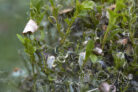
Sometimes, those white spots are actually good news! New leaf buds are covered in a protective waxy layer. When the boxwood starts its spring growth spurt, these bud scales burst open and can get stuck on the leaves, looking like white flakes. If your boxwood looks healthy otherwise and you don’t see any creepy-crawlies, don’t sweat it. These flakes are totally harmless and will eventually fall off on their own.