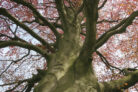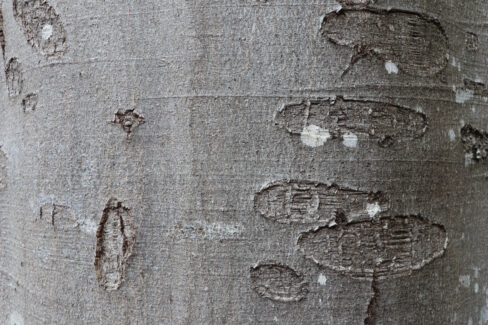
The European Beech (Fagus sylvatica) has one of those iconic looks you just can’t miss. Most of us recognize that signature smooth, almost silvery bark right away. But there’s actually a lot more to a beech tree’s “skin” than just its color and texture!
Bark on Young vs. Old Trees
When they’re just little saplings, young beech trees and fresh shoots start out with a dark green or even blackish hue and a very smooth surface. It doesn’t stay that way for long, though—the bark begins to lighten up pretty quickly as the tree grows.
On mature trees, the trunk and branches take on that classic light gray to silvery tone. Even the old giants keep that smooth silver look high up in the canopy, but you’ll notice the base of the trunk starts to get a bit “craggy.” These cracks happen naturally as the tree expands in girth. You’ll also see “scars” on older trees where branches have fallen off or been pruned away. Another cool quirk of older beeches? As the bark stretches and cracks from growth, the tree produces a new protective layer called the cork cambium. This cork eventually crumbles into a fine, light gray dust that you can often find scattered around the base of the tree. Just don’t expect to peel off big chunks like you would with a Cork Oak—it’s much more delicate than that!
Here are the key features of beech bark to keep in mind:
- Dark green to black bark on young trees.
- Generally smooth texture, with fine cracks appearing only as the tree ages.
- Silvery-gray color on mature specimens.
- Visible scars from old branches or past injuries.
- Deeper cracks at the base of old trees due to trunk expansion.
- Fine cork dust on the ground nearby (no large cork plates).
- The bark is never “shed” or sloughed off, regardless of age.
One big plus of having such smooth bark is that there aren’t many hiding spots for pests or insects. This keeps wood-boring infestations to a minimum. However, if the bark gets a deep “wound,” fungi and pests can find a way in. It’s also worth noting that beech bark is surprisingly sensitive to direct, intense sunlight. To keep your tree happy, I recommend planting some low-growing companions around the base to provide a little shade. Small hornbeams or flowering subshrubs are perfect for the job!